Santa Monica is the western terminus of Route 66, where the highway from Chicago finally reaches the Pacific coast.
2,290 mi from Chicago
4 stories to hear
Free in the app through 2027
Allow one cookie to recognise return visits? No cross-site tracking. Privacy
About Santa Monica
Santa Monica was founded in 1875 on land of the old Rancho San Vicente y Santa Mónica and grew into a seaside resort, with Palisades Park, the Santa Monica Pier and the Hotel Casa del Mar among its attractions. Like the ranchos before it, the city took the name of Saint Monica.
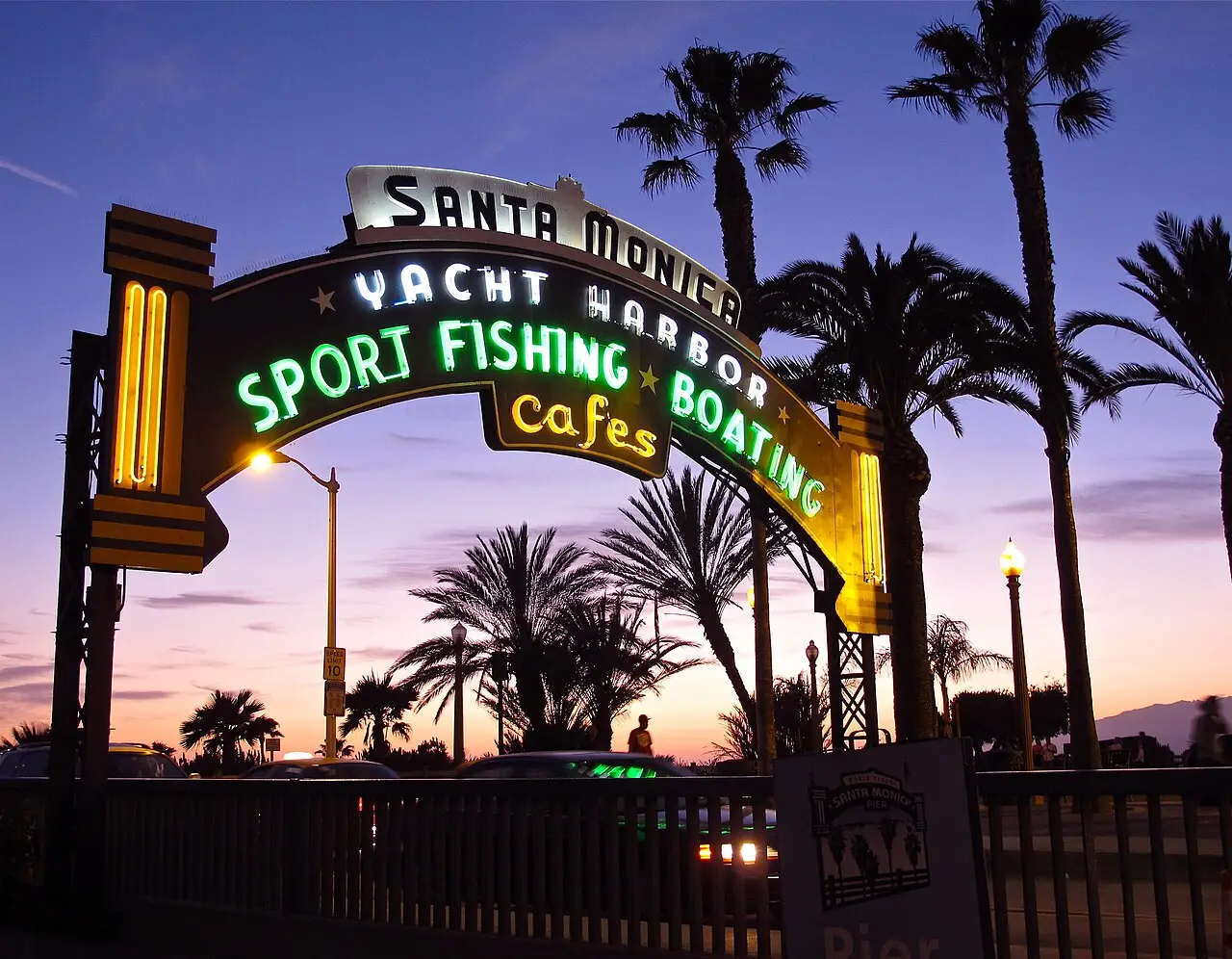
Route 66 first ended in downtown Los Angeles and was extended here in the 1930s. Its official western end is at Lincoln and Olympic boulevards, where a sign marking the end stands in front of Mel's Drive-In. The nearby pier became the road's “symbolic” end.
On the road, Lorecast plays these on its own as you drive past each place. Here you can listen first. Each story lists its sources.
HISTORY · TOLD BY MILES · 62 SEC
Where the fitness boom began
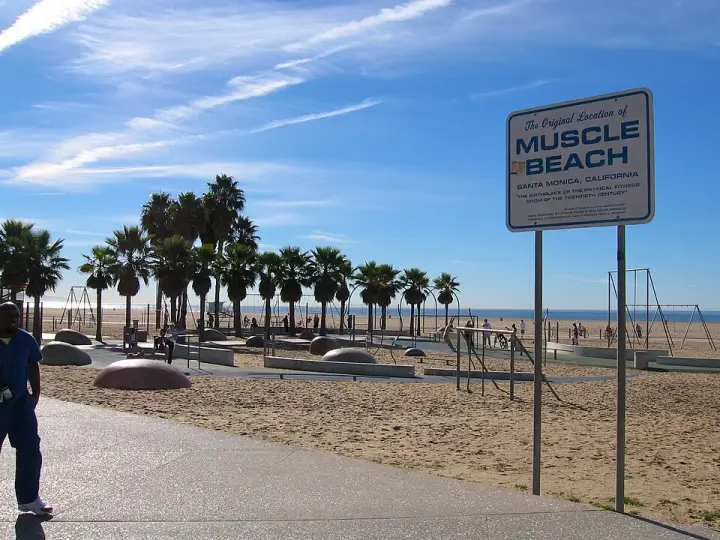
In 1934, something unexpected started happening on the beach just south of the Santa Monica Pier. The Works Progress Administration had installed exercise equipment there, part of a New Deal program. But what grew out of that was not just a workout spot—it became the birthplace of the entire physical fitness boom in the United States. Gymnasts and acrobats began putting on public exhibitions on city-provided equipment, drawing crowds. Then bodybuilders arrived: Vic Tanny, Jack LaLanne, Joe Gold—names that would define fitness culture. They trained on a simple weightlifting platform on the sand. For decades, this stretch of beach was where the modern fitness movement took shape. In 1989, the city officially dedicated the original Muscle Beach, and today it still serves gymnasts and acrobats with an extensive training area.
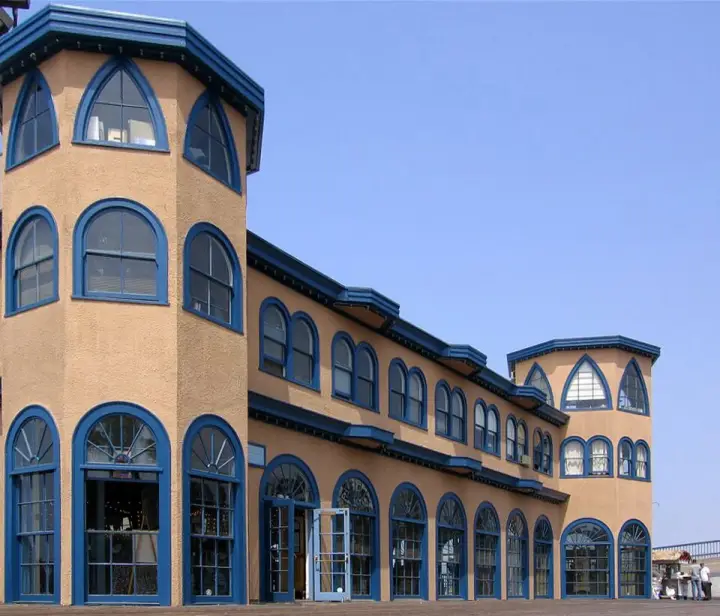
On June 12, 1916, the Looff Hippodrome opened its doors. Charles I. Looff and his son Arthur built it to house a Looff Carousel—a rare survivor from the golden age of amusement piers. But the carousel you'd ride today isn't that one. The original was sold in 1939, replaced by Philadelphia Toboggan Company Carousel #62, moved from the Ocean Park Pier. For decades, the city tried to tear the whole pier down—even approved a plan for a resort island in the bay. Local activists in Save Santa Monica Bay fought back, and in 1973 the demolition order was revoked. The city bought the pier in 1974, restored the Hippodrome and rebuilt the carousel inside. It became a National Historic Landmark in 1987.
Saint Monica, finished by the Mount Rushmore sculptor
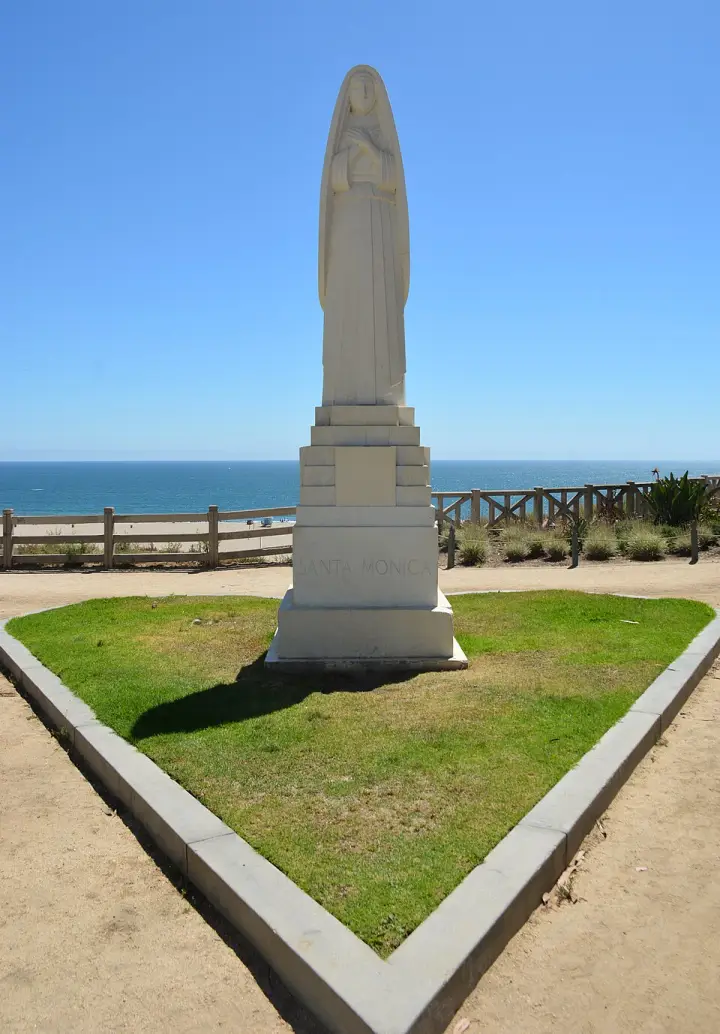
Here's the odd bit: the city's namesake statue was finished with a little help from the man who carved Mount Rushmore. Gutzon Borglum himself came to Santa Monica to help his friend, sculptor Eugene Morahan, put the finishing touches on this Art Deco Saint Monica before her 1935 unveiling. The cast-cement figure stands about ten feet tall in Palisades Park, overlooking the Pacific. The whole thing was a New Deal project — the city paid for materials, and the regional director, Merle Armitage, was unusually good at raising matching funds. At the dedication, the Santa Monica Municipal Band played, and dignitaries gathered for a 'Pioneer Days' event. Decades later, a character in a novel drives his Mustang all the way to the end of Wilshire, where the white statue still stands, surrounded by gnarled trees and a patch of grass shaped like a heart.
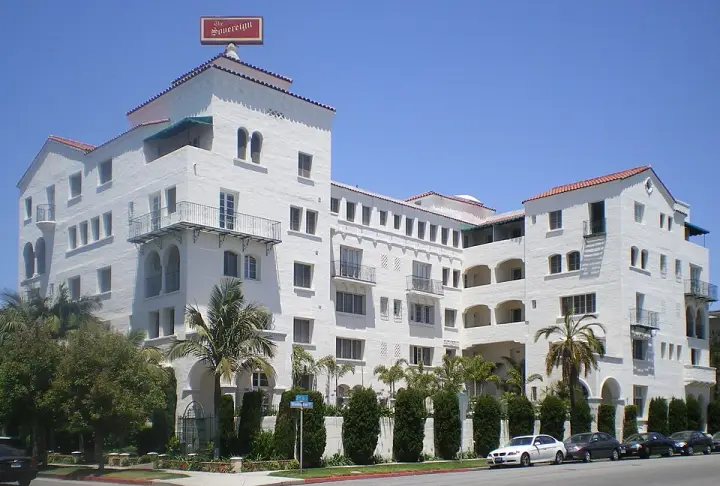
The Sovereign Hotel in Santa Monica—what kind of architect builds with no reticence at all? Built in 1928, it was designed by architect Kurt Meyer-Radon and the Anglo American Building Company in the Mission Revival-Spanish Colonial Revival styles. The result: a large five-story, 86-unit hotel and apartment building, mostly bachelor, studio, and one-bedroom units. In the 1930s, the operation seems to have shifted toward a more traditional hotel, with a small wing added that may have contained a dining room—and the street-level sign reading 'Sovereign Hotel' dates from that same period. Architectural historians David Gebhard and Robert Winter put it plainly: 'There was no reticence here on the part of the architect in showing how many Spanish Colonial Revival forms and details could be used.' It earned its place on the National Register of Historic Places in 1997.
Route 66's official western end, where it met U.S. 101A. A sign marking the end stands in front of Mel's Drive-In, built in 1959 in the Googie style as the Penguin Coffee shop and reopened in 2018.
The road's “symbolic” end. It joins the 1909 Municipal Pier, built to carry sewer pipes, and the Looffs' 1916 Pleasure Pier, whose Hippodrome houses a 1922 carousel. Pacific Park opened in 1996.
Just south of the pier, where the U.S. physical fitness boom began in 1934 on WPA exercise equipment. Jack LaLanne and Joe Gold trained here; it is still a gymnastics training area.
A park on the bluffs along Ocean Avenue, set aside in 1892. Eugene Morahan's Art Deco statue of Saint Monica, dedicated in 1935, stands where Wilshire Boulevard ends.
A restaurant since 1959, when actor Jay Fiondella bought the struggling Dawn Cafe for one dollar. Long a Hollywood haunt, it was saved from redevelopment as a Santa Monica Historic Landmark.
A five-story hotel and apartment building from 1928. Its architect showed “no reticence” in using Spanish Colonial Revival forms, wrote David Gebhard and Robert Winter. On the National Register since 1997.
Let Santa Monica tell its own stories as you drive in.
Lorecast plays short stories about the places around you, hands-free. Download Route 66 before you leave and it works offline. Route 66 is free through December 31, 2027.
How these stories are made
Lorecast stories are written with AI using only the sources listed under each story, and they are narrated with synthetic voices. An automatic check traces every name and date back to those sources, and legends are told as legends. Every story on this page was also checked against its sources before we published it here. If you spot a mistake, write to hello@lorecast.net.