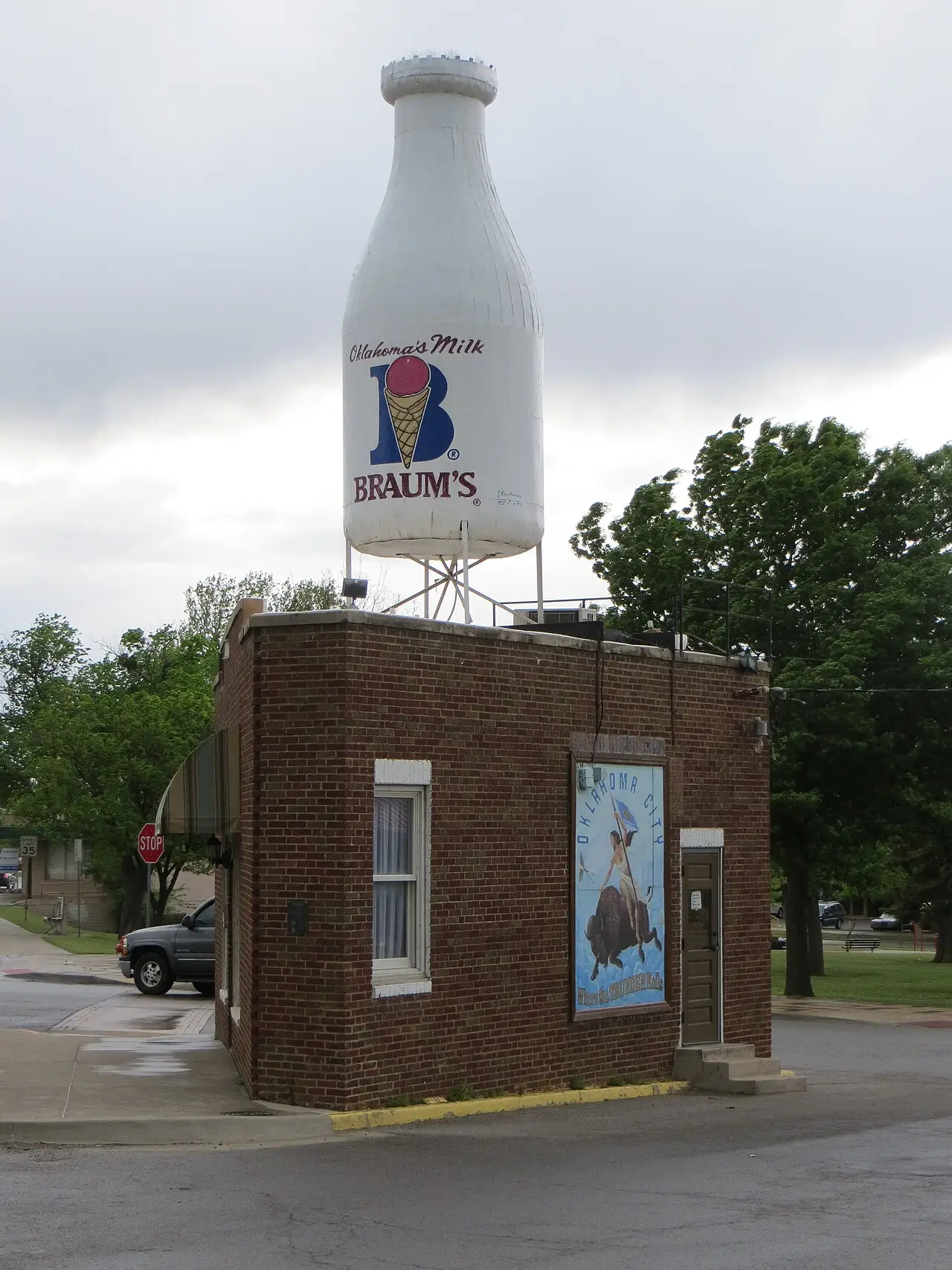
Oklahoma’s capital, where the old Route 66 corridor of Classen Boulevard and 23rd Street is marked by the Milk Bottle Grocery and the Gold Dome.
830 mi from Chicago
4 stories to hear
Free in the app through 2027
Allow one cookie to recognise return visits? No cross-site tracking. Privacy
About Oklahoma City
Oklahoma City was settled on April 22, 1889, when the Unassigned Lands opened in the Land Run, and it had more than 10,000 people within hours. By statehood in 1907 it had outgrown the territorial capital, Guthrie, and the capital soon moved here.
Route 66 was signed through the city by 1929. It came in on 39th Street, ran down Classen Boulevard and east on 23rd Street, and turned north at Lincoln Boulevard by the State Capitol. Bobby Troup’s 1946 song “(Get Your Kicks on) Route 66” names the city; in 1953 the highway moved to new expressways.
On the road, Lorecast plays these on its own as you drive past each place. Here you can listen first. Each story lists its sources.
HISTORY · TOLD BY MILES · 66 SEC
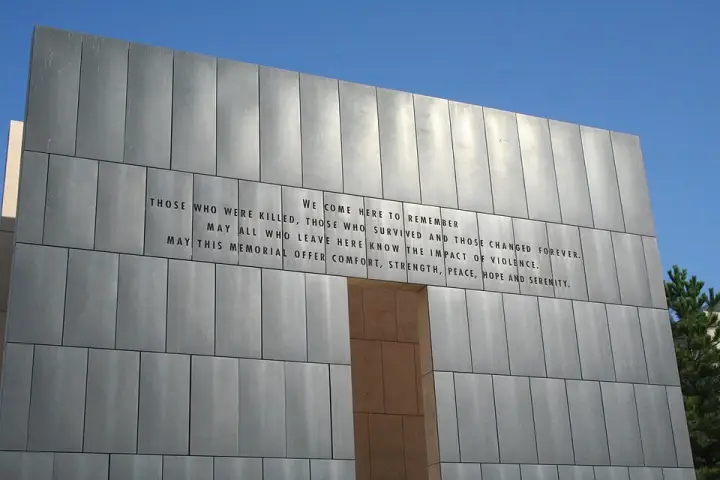
The memorial at 9:02
April 19, 1995, 9:02 a.m. — that's the moment frozen here. A Ryder truck bomb destroyed the Alfred P. Murrah Federal Building, killing 168 people. But what happened next is the real story. The city didn't just rebuild. They asked for a memorial. Six hundred twenty-four designs came in. The winning one? From a husband-and-wife team, Hans and Torrey Butzer. Their design includes 168 empty chairs — glass, bronze, and stone — one for each life lost. Nineteen are smaller, for the children. Three unborn children are listed on their mothers' chairs. And there's a Survivor Tree, an American elm that was shredded by the blast but lived. Its seeds are planted every year; saplings go out on the anniversary. Thousands now grow across the U.S. The memorial opened in 2000. Since then, over 4 million people have visited.
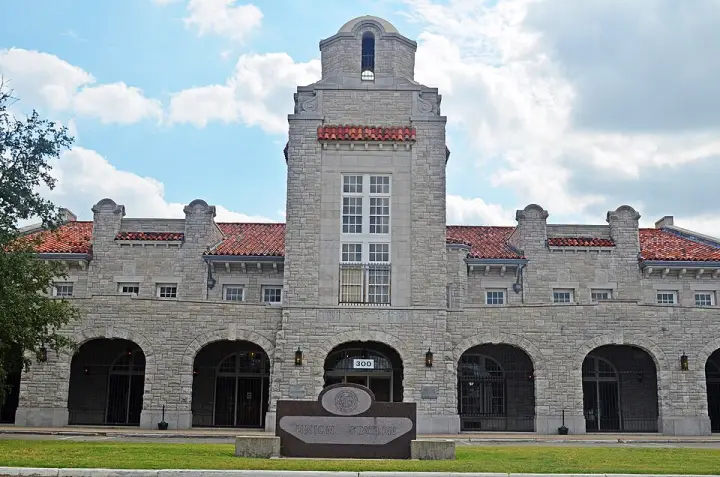
In 1931, Oklahoma City opened Union Station — a sprawling California Spanish Mission Revival building with 55,000 square feet on its main floor. It was built as part of a plan to move surface rail lines and passenger stations of the Rock Island and Frisco railroads out of downtown. The city issued bonds to buy back the rights of way and pay for new civic buildings on the vacated land. For 36 years, trains like the Choctaw Rocket and the Meteor rolled through here. But the station closed in 1967, after the last passenger trains stopped. Today it houses the offices of the Scissortail Park Foundation.
What does it take to open a restaurant at 22, with a single table and a second-hand stove? Florence Jones Kemp, a sharecropper's daughter from Boley, Oklahoma, found out in 1952. She later said, 'I decided that I needed a job and I didn't like working for other people.' So she started Florence's Restaurant on 4th Street near Deep Deuce. Within two years, she had saved enough from her profits to send her sister to college. The restaurant moved several times—at least once because of urban renewal—but by 1969 it had settled at the northeast corner of NE 23 and Fonshill in Oklahoma City. In 2022, the James Beard Foundation named it one of America's Classics. Not bad for a place that began with one table and a stubborn young woman who refused to work for anyone else.
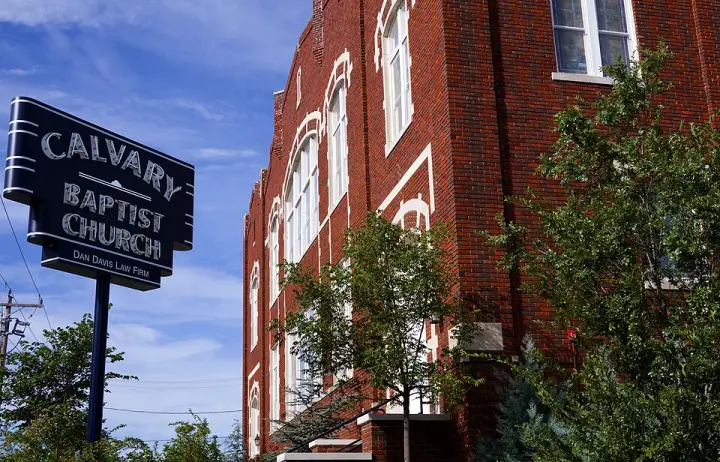
What does an Oklahoma City law office have in common with Martin Luther King Junior? Quite a lot, as it turns out. Calvary Baptist Church at 2nd and Walnut Streets—also known over time as Second Street Baptist Church and Saint Paul Baptist Church—was built in 1921 and added to the National Register of Historic Places in 1978. But its real claim to history is that Martin Luther King Junior spoke in this church during the Civil Rights movement. The same room that once held his voice now serves a different purpose: in 2012, Dan Davis Law purchased the building for office use and spent more than $2,000,000 in renovations to bring it back to its former life. A Baptist church turned law firm, listed on the National Register, still standing at 2nd and Walnut since 1921.
A 1930 triangular grocery at 2426 N. Classen Boulevard. The big metal milk bottle went up on its roof around 1948, to be seen by traffic on Classen, then part of Route 66.
A 1958 geodesic-dome bank at NW 23rd Street and Classen Boulevard, the fifth geodesic dome built in the world and the first used as a bank. A 2001 demolition plan drew protests, and it was saved.
A 1931 California Spanish Mission Revival depot that served the Rock Island and Frisco railroads until 1967. It now houses the offices of the Scissortail Park Foundation.
On the site of the Alfred P. Murrah Federal Building, bombed on April 19, 1995: the Gates of Time, the Reflecting Pool, 168 empty chairs and the Survivor Tree. The outdoor memorial is open day and night.
Florence Jones Kemp opened her restaurant in 1952; since 1969 it has stood at NE 23rd and Fonshill. In 2022 it won a James Beard America’s Classics award, the first James Beard award for an Oklahoma entity.
Oklahoma City is about 830 miles from Chicago along the route. It is on day 5 of our 14-day plan.
Arcadia Round Barn 20 mi east
Built in 1898 by farmer William Harrison Odor from bur oak boards bent while green. Route 66 was laid right past it in the 1920s; the roof collapsed in 1988, and volunteers finished rebuilding it in 1992.
From 1926 to 1958 Route 66 ran along the north shore of Lake Overholser. That original stretch, with its bridge, survives as North Overholser Drive and is considered one of the most scenic sections of the old road.
Let Oklahoma City tell its own stories as you drive in.
Lorecast plays short stories about the places around you, hands-free. Download Route 66 before you leave and it works offline. Route 66 is free through December 31, 2027.
How these stories are made
Lorecast stories are written with AI using only the sources listed under each story, and they are narrated with synthetic voices. An automatic check traces every name and date back to those sources, and legends are told as legends. Every story on this page was also checked against its sources before we published it here. If you spot a mistake, write to hello@lorecast.net.